

Let us see about India’s paper industry below in detailed.
Paper shows up in our lives every single day. For instance, we grab notebooks for school, boxes for online orders, and files for work. Moreover, India’s paper makers build this essential supply chain, expanding steadily over decades to meet needs in homes, schools, and businesses.
How It Began
India launched paper production in 1812 with its first mill in Serampore near Kolkata. However, low demand closed it quickly. After independence in 1947, leaders actively promoted local manufacturing. As a result, mills popped up rapidly in the 1950s and 1960s, sourcing bamboo and grass from nearby forests. Today, therefore, India holds the 15th position among global paper producers.
West Bengal grabbed the early lead, thanks to accessible bamboo from Assam. Later, Gujarat and Tamil Nadu stepped up with clever recycling and tree plantations. In addition, the country now operates about 526 active mills out of 900 constructed over the years. Consequently, small and medium mills thrive, creating jobs across the nation.
Key points from history:
- First mill opened in 1812 at Serampore.
- Post-1947 boom followed government support.
- Makers moved from cutting wild forest trees to growing trees on farms and using old waste paper.
Size Today
India runs a massive paper operation. Makers churn out around 25 million tons annually, generating ₹80,000 crores in recent sales. Furthermore, the sector expands at 8% per year over the last five years. Notably, Indians consume just 15 kg per person—well below the global 58 kg or America’s 320 kg—so vast growth potential exists.
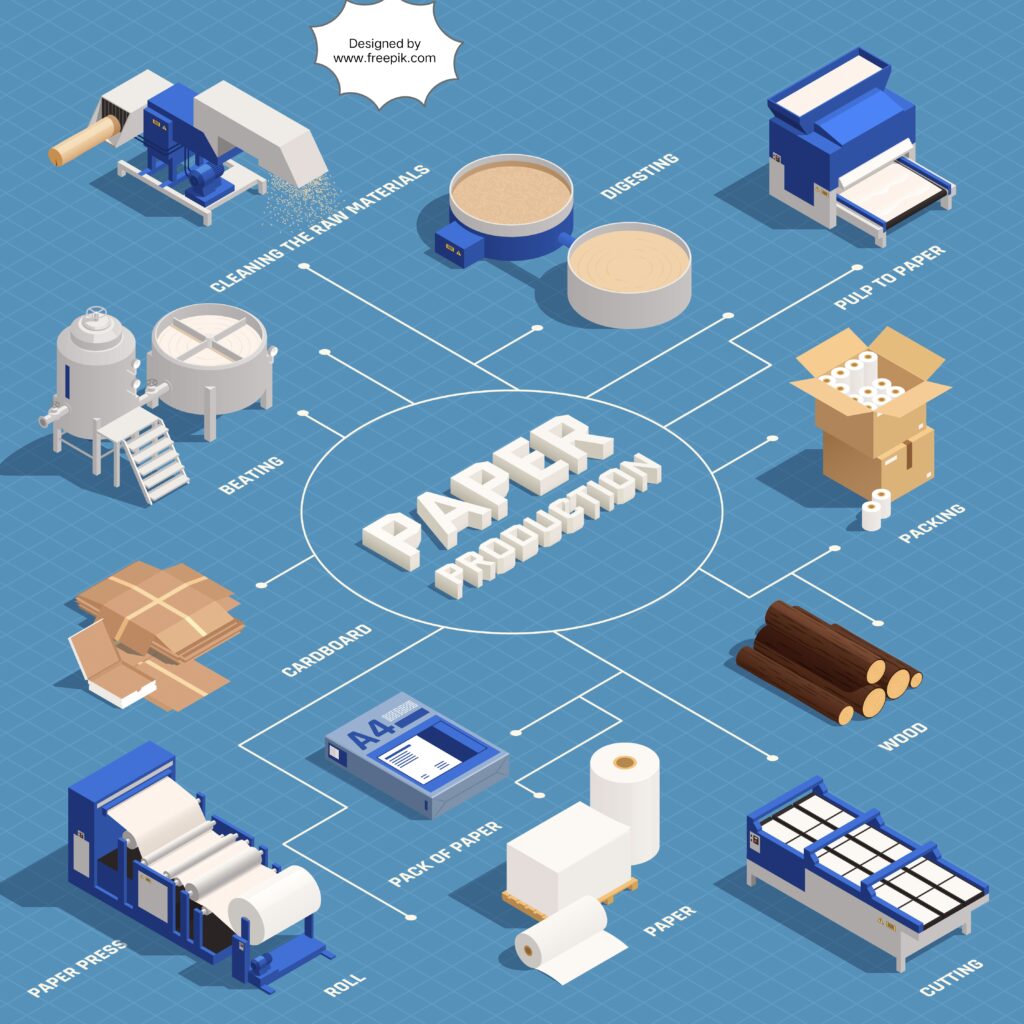
Image by www.freepik.com
Four key types dominate the market:
- Packaging paper and board seize 57%, powering e-commerce and food boxes.
- Printing and writing paper claim 30%, supplying notebooks and office prints.
- Newsprint keeps 8%, though digital news erodes its slice.
- Specialty paper takes 5%, excelling in labels and filters with high profits.
Producers pocket 14% average profits, and specialty types exceed 18%. Additionally, the industry hires 0.5 million directly and supports 1.5 million in related roles.
| Segment | Share | Main Uses |
|---|---|---|
| Packaging | 57% | Boxes, cartons |
| Printing/Writing | 30% | Notebooks, printouts |
| Newsprint | 8% | Newspapers |
| Specialty | 5% | Labels, tissues |
Mills and Materials
Mills spread widely from north to south India. For example, Gujarat tops recycling, delivering 22% of reused paper. Similarly, Tamil Nadu leads in wood pulp from farmed trees. Meanwhile, Andhra Pradesh rules specialty papers, and Uttarakhand specializes in printing varieties. Odisha and Madhya Pradesh manage newsprint effectively.
Waste paper supplies 70-75% of raw materials, while imports cover 25% of wood pulp needs. Locally, recycled sources provide 52%, wood 28%, and farm waste like bagasse 20%. Thus, mills plant their own trees and collect sugarcane leftovers to cut costs and aid the environment. Above all, India shines at converting farm waste into quality paper.
Important hubs:
- Gujarat dominates recycling.
- Tamil Nadu excels in wood and agro.
- Nepanagar in MP operates a major newsprint mill since 1956.
Growth Reasons
E-commerce surges and craves more boxes. At the same time, schools multiply, so children demand books and copies. Green regulations also favor recycled packaging. Therefore, demand may double to 35 million tons by 2035 from 22 million today. In fact, Asia consumes half the world’s paper, and India leads growth at 4-5% yearly.
FMCG products, retail outlets, and health packaging fuel the fire. Government literacy programs and business expansion assist too. Even as phones reduce some reading, packaging and prints remain robust.
Growth drivers:
- Online shopping explodes.
- Education grows with extra books.
- Eco-packaging regulations advance.
- Farm waste gains new purpose.
Problems and Solutions
Cheap pulp imports from China strike hard, disrupted by trade policies and rupee fluctuations. Digital news further shrinks newsprint needs. Old equipment and small mill sizes drive up costs. Water and power shortages hinder progress too.
Small mills compete poorly against global giants. Raw wood shortages demand more plantations. Hence, solutions call for advanced technology, larger facilities, and domestic pulp production. Groups like IPPTA advocate for duty relief and recycling support.
Challenges list:
- Imports slash prices.
- Newsprint demand falls.
- Energy costs climb.
- Raw materials dwindle.
Green Efforts and Future
Producers recycle over 70%, preserving trees. They establish large plantations for steady wood. Sugar mill bagasse reduces waste heaps. New technology cuts water and power consumption. Specialty eco-papers advance swiftly.
A growing middle class and retail surge ignite demand. The government targets increased local output to reduce imports. Thus, robust growth looms by 2030 if obstacles vanish. Jobs will expand, and India will rise in global standings.
Sustainability wins:
- Mills establish tree farms.
- Waste paper finds reuse.
- Processes conserve water.
- Packaging turns greener.
Top Companies and Impact
Giants like ITC, JK Paper, and Ballarpur operate cutting-edge mills. They combine traditional skills with modern techniques. Small mills preserve local employment. Paper kicks off our mornings with news and wraps up evenings with delivery boxes. As India advances, this industry juggles jobs, eco-friendly methods, and daily essentials.
Conclusion
India’s paper industry stands tall today, powering everyday needs with grit and smart changes. Makers started small in 1812 but exploded after 1947, turning forests into farms and waste into wealth. Now, they pump out 25 million tons yearly, grabbing ₹80,000 crores while hiring millions. E-commerce boxes, school notebooks, and green packs drive the boom ahead.
Sure, cheap imports and old machines pose hurdles, yet solutions shine bright. Mills recycle 70% already, plant trees, and grab sugarcane leftovers to save the planet. Gujarat recycles like champs, Tamil Nadu grows farm wood, and leaders like ITC blend old tricks with new tech. As online shopping surges and education spreads, demand doubles by 2035.
This sector feeds jobs, trade, and growth in a rising India. Small mills keep locals busy, big ones chase global spots. Phones cut newsprint, but packaging rules supreme. Government pushes local pulp to slash imports. Watch eco-papers and specialty wins multiply profits.
In short, determination wins here. From Serampore struggles to 526 buzzing mills, producers balance people, profits, and nature. India’s paper tale inspires—expect greener innovations, more hubs, and a top-10 global leap soon. Families unwrap deliveries, kids scribble dreams, businesses pack dreams—all on homegrown sheets. The future rolls smooth, one recycled roll at a time.




India’s paper industry has evolved into a sustainable, high-growth sector with strong job creation and vast future potential.
👍