
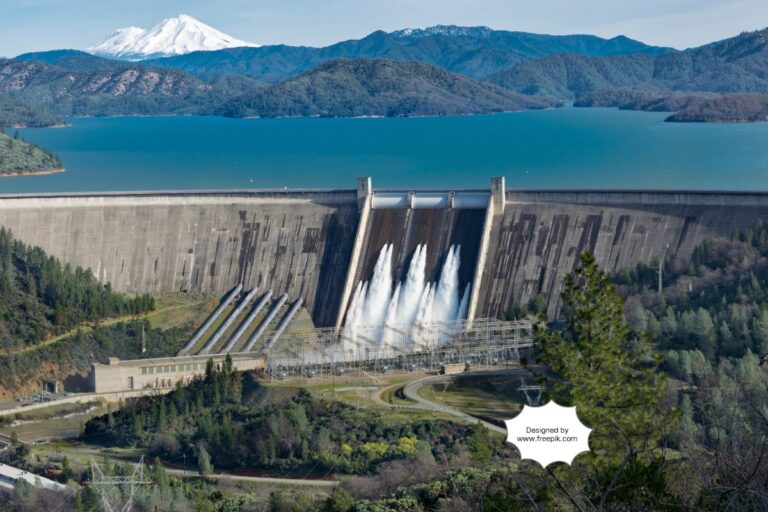
Let us see about Hydro Power in India below in detailed.
India’s hydro power sector grows fast because rivers flow strongly across mountains and plains. This clean energy source powers homes, factories, and lights cities without much pollution. First, let’s explore what hydro power means, then dive into its types, history, and future plans.
What Is Hydro Power?
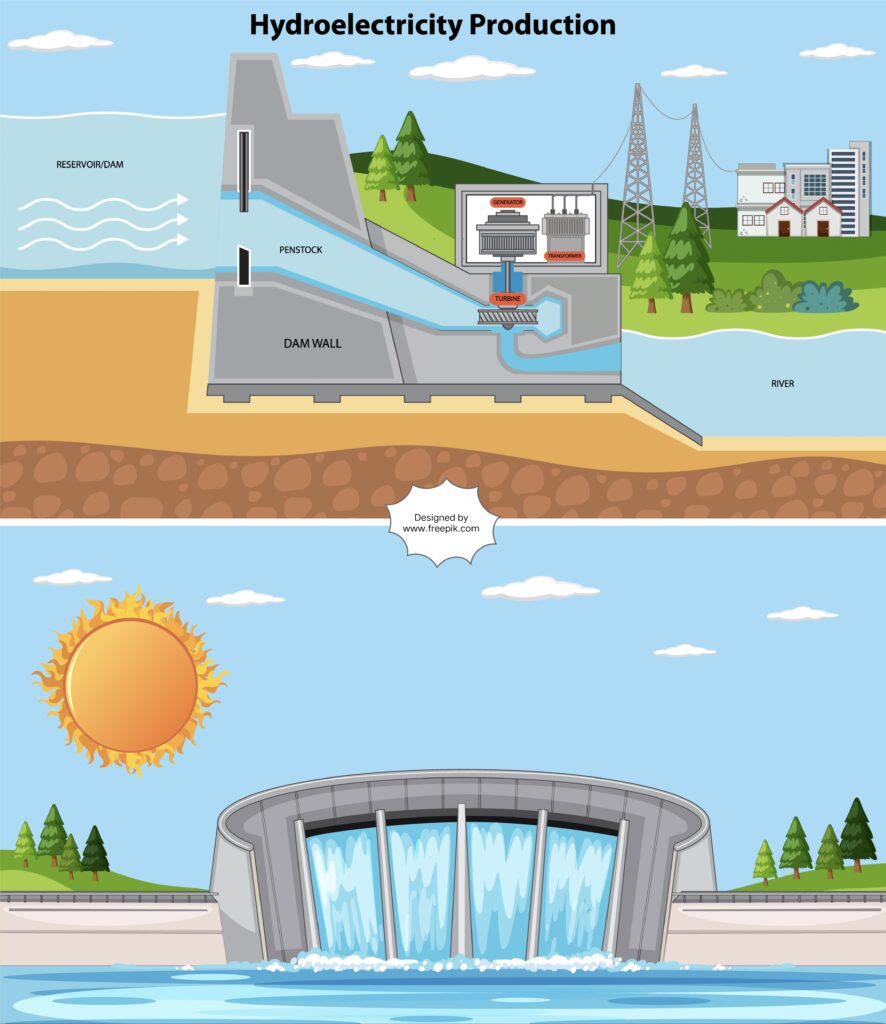
Hydro power comes from moving water. Water rushes through turbines in dams, and this turns generators to make electricity. In India, rivers like Ganga, Brahmaputra, and Narmada provide plenty of water for this. Moreover, engineers build dams to control floods and store water for dry times. As a result, hydro power gives steady energy day and night, unlike solar that stops at night. Farmers use it for pumps, and cities get reliable lights.
Key benefits make hydro power popular:
- It costs little to run after building the dam.
- No fuel needed, so prices stay low.
- Helps fight climate change by cutting coal use.
However, building dams takes time and money. Still, India pushes hydro because demand for power rises every year.
Types of Hydro Power Plants
India uses different kinds of hydro plants based on water flow and size. Large plants make big power for the whole country. Small ones help villages. Let’s break them down.
Large Hydro Plants
These giants produce over 25 MW each. They sit on big rivers with tall dams. For example, Tehri Dam in Uttarakhand stands at 260 meters high. It pumps out 1000 MW, enough for lakhs of homes. Additionally, such plants store water for irrigation too. Therefore, they boost farming in dry areas.
Top large plants include:
- Bhakra Nangal on Sutlej River (1325 MW).
- Sardar Sarovar on Narmada (1450 MW).
- Indirasagar in Madhya Pradesh (1000 MW).
Farmers cheer these because they get water in summer. Cities get power without blackouts.
Small and Mini Hydro Plants
Small plants make 2 to 25 MW. Mini ones do under 2 MW. They fit in hills where big dams can’t go. Sikkim and Himachal lead here. For instance, a mini plant in a stream powers 500 homes nearby. Moreover, villagers run them with local help, so jobs stay in the area.
Advantages stand out:
- Quick to build, often in one year.
- Low cost, around Rs 5 crore per MW.
- No big floods risk.
Next, pumped storage hydro acts smart. It pumps water uphill when power extras exist. Then, it releases water to make power at peak times. Ratnagiri plant does this well.
History of Hydro Power in India
India started hydro early. In 1897, Darjeeling got Asia’s first plant. It lit 130 bulbs! Then, 1902 brought Shivanasamudra in Karnataka for Mysore city. British rulers built these for factories.
Post-independence, Nehru called dams “temples of modern India.” So, 1950s saw a boom. Bhakra came in 1963. By 1980, capacity hit 10,000 MW. However, 1990s slowed due to protests over displaced people.
Today, growth picks up again. Government adds 500 MW yearly. As of 2026, total installed power reaches about 47,000 MW for large hydro. Small hydro adds 5,000 MW more. Together, they make 12% of India’s power.
Current Status and Key Stats
Hydro power holds strong in 2026. India taps only 20% of its 150,000 MW potential. North and Northeast lead. Arunachal has 50% untapped power. Himachal gives 25% of its electricity from hydro.
In 2025, plants made 134 billion units. This year, expect more with new starts. NHPC, a top company, runs 7000 MW and plans double by 2027.
State-wise leaders:
- Maharashtra tops with 3000 MW.
- Karnataka follows at 2500 MW.
- Himachal at 2000 MW.
Rivers fuel this. Brahmaputra basin holds 70,000 MW possible. Ganga adds 20,000 MW. However, monsoons affect output. Dry years drop power by 20%.
Capacity grows because:
- New projects like Subansiri (2000 MW) near finish.
- Joint ventures with states speed work.
- Green bonds fund clean hydro.
Major Projects Under Way
India builds big now. Subansiri Lower in Assam and Arunachal nears 2000 MW. It took 20 years but finishes soon. Parbati-II in Himachal adds 800 MW by mid-2026. Dibang, India’s largest at 2880 MW, drills in Arunachal hills.
Northeast shines. Heo (240 MW) and Tato-I (186 MW) start soon, costing Rs 3700 crore. They finish in 50 months. Jammu Kashmir sees Kiru (624 MW) and Ratle (850 MW). These fight power shortages there.
Challenges slow some:
- Tough mountains delay roads.
- Locals fear floods sometimes.
- But, tech like tunnels fixes issues.
Government clears 20 GW hydro pipeline. So, expect 10,000 MW new by 2030.
Benefits for India
Hydro power changes lives. First, it cuts coal imports worth Rs 2 lakh crore yearly. Clean air helps kids breathe easy. Second, dams irrigate 40 million hectares. Farmers grow two crops now.
Jobs boom too. One MW creates 10 jobs in building. Villages get schools and roads near plants. Moreover, tourism grows around lakes like Govind Sagar.
Economy wins big. Hydro saves Rs 1 per unit over coal. Industries run smooth without hikes. As a result, exports rise.
Challenges and Fixes
Not all smooth. Monsoon dips output sometimes. So, solar hybrids help. Dams flood forests, upset locals. Thus, rehab moves 1 lakh people with houses and cash.
Earthquakes worry in Himalayas. Engineers use strong designs now. Moreover, silt chokes turbines. New tech cleans it fast.
Government acts:
- Gives free power to locals.
- Speeds green nods.
- Pushes small hydro in 6000 sites.
Future Plans and Trends
India eyes 70,000 MW hydro by 2030. Pumped storage doubles to 5000 MW. Green hydrogen pairs with hydro too.
Trends excite:
- Floating hydro on reservoirs.
- Run-of-river plants, no big dams.
- Private firms join via auctions.
By 2070, hydro hits net-zero goals. Northeast exports to Bangladesh. Tech like drones checks dams quick.
Why Hydro Matters Now
Hydro power fits India’s needs perfect. Power demand jumps 8% yearly. Coal pollutes, solar stores tough. Hydro fills gaps. Plus, it fights global warming.
Communities thrive near plants. Schools light up, hospitals run 24/7. Farmers smile with steady water. Therefore, India builds more.
In short, hydro powers dreams. It lights futures bright. Next time you switch a bulb, thank the river!


Nice information
👍