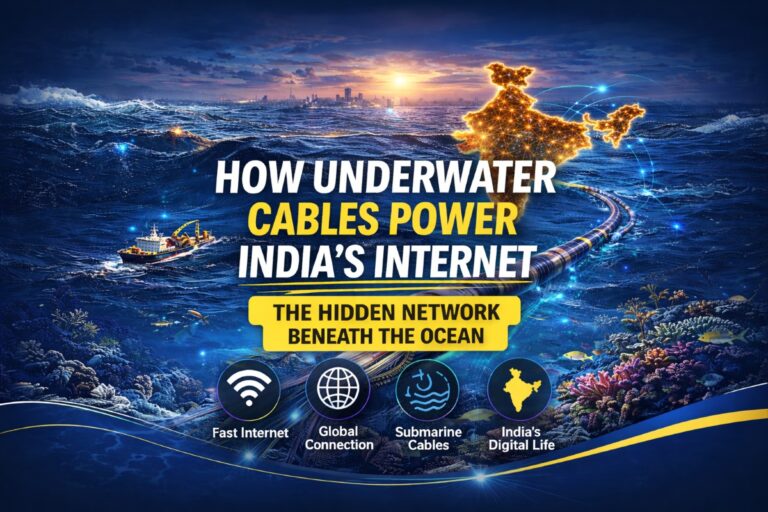
Let us see about 95% of India’s Internet Runs Under the Ocean below in detailed.
When you open YouTube, send a WhatsApp message, or scroll Instagram, you probably think satellites make all of this work. But that is not true. In fact, most of India’s internet runs through cables lying deep under the ocean. These cables stay hidden from our eyes, yet they carry almost all global data every second.
🌐 What Are Underwater Internet Cables?
Underwater internet cables are long fiber-optic wires placed on the ocean floor. These cables carry data in the form of light signals. Because light travels very fast, your messages and videos move across countries in just seconds.
For example, when you open a website hosted in another country, your data does not go to space. Instead, it travels through these cables under the sea.
In simple words:
👉 No cables = No fast internet
📍 Where Are These Cables Around India?
India connects to the world through many submarine cable landing stations. These stations sit on coastal areas and connect land networks to sea cables.
Some key landing points include:
- Mumbai
- Chennai
- Kochi
- Tuticorin
These cities act like internet gateways. Because of this, they handle huge amounts of data every day.
🔌 How Do These Cables Actually Work?
Let’s break this down step by step:
- First, your phone sends a request (for example, opening Google).
- Then, the request moves through local internet towers and data centers.
- After that, it reaches a coastal landing station.
- From there, the data travels through underwater cables to another country.
- Finally, the response comes back the same way.
As a result, all of this happens within seconds.
Also, these cables use fiber optics. That means they send data as light pulses, not electricity. Therefore, they stay fast and efficient over long distances.
⚡ Why Doesn’t India Depend on Satellites?
Many people think satellites run the internet. However, that idea is not fully correct.
Here’s why cables are better:
- Cables carry much more data than satellites
- They offer faster speed
- They cost less in the long run
- They provide stable connections
On the other hand, satellites face delays and limits. So, companies prefer cables for heavy internet traffic.
🌏 Major Cable Systems Connected to India
India connects with multiple global cable networks. These cables link India to regions like Europe, the Middle East, and Asia.
Some important systems include:
- SEA-ME-WE (South East Asia–Middle East–Western Europe)
- IMEWE Cable
- IAX Cable System
These systems form a global web. Because of this, data can take different routes if needed.
🚨 What Happens If a Cable Breaks?
Now, this part may surprise you.
Cables can break due to:
- Ship anchors
- Fishing activities
- Earthquakes under the sea
- Natural wear and tear
When a cable breaks, internet speed can slow down. Sometimes, certain services may stop working for a while.
For example, India has faced slow internet issues in the past due to cable damage near international routes.
However, backup systems usually handle the load. So, users may not always notice major problems.
🛠️ How Do Companies Fix These Cables?
Fixing underwater cables is not easy.
First, companies detect the fault location. Then, special repair ships go to that area. After that, they pull the cable up from the ocean floor.
Next, technicians repair or replace the damaged part. Finally, they place the cable back carefully.
This process may take days or even weeks. Therefore, maintaining these cables requires high skill and effort.
🏢 Who Owns These Cables?
Different companies and organizations build and manage these cables.
Some major players include:
- Tata Communications
- Reliance Jio
- Meta
These companies invest billions of dollars into cable networks. Because of that, they control large parts of global internet traffic.
🔐 Why Are These Cables So Important for India?
These cables play a huge role in India’s growth.
Here’s how:
- They support IT services and outsourcing
- They help businesses connect globally
- They enable online education and work-from-home
- They power apps, banking, and digital payments
Without these cables, India’s digital economy would slow down heavily.
📊 Interesting Facts You Probably Didn’t Know
Let’s look at some surprising facts:
- Around 95% of global internet data travels through underwater cables
- These cables stretch for thousands of kilometers
- Some cables are as thin as a garden hose
- Sharks have damaged cables in rare cases
Yes, even marine life sometimes affects the internet!
🚀 Future of Underwater Cables in India
is expanding its digital infrastructure quickly. Therefore, new cable projects are coming up.
For example:
- New cables aim to increase internet speed
- More landing stations will reduce network load
- Private companies are investing heavily
As a result, India will become a stronger digital hub in the future.
🧠 Why Most People Don’t Know About This
Even though these cables are very important, people rarely talk about them.
This happens because:
- They stay hidden under the ocean
- They work silently without attention
- Most users only care about speed, not source
However, once you understand them, you see the internet differently.
✍️ Final Thoughts
Underwater internet cables may stay out of sight, but they power almost everything we do online. From sending messages to watching videos, these cables make modern life possible.
So next time your internet works smoothly, remember this:
👉 Your data is traveling thousands of kilometers under the ocean in seconds.
That hidden journey connects India to the entire world.